The mere mention of the words "Parthenon Marbles" (also know as the Elgin Marbles) ignites a passionate debate in which everyone seems to have an opinion. I would like to share my opinions, which I'm sure many will agree with, though I know there are plenty who will think I'm wrong. The Parthenon Marbles were stolen, plain and simple. Now, before you jump to your own conclusions about my views, hear me out. The Parthenon Marbles where stolen from Greece between 1801 and 1812, and subsequently found their way to the British Museum. Thomas Bruce, the 7th Earl of Elgin, was the British ambassador to the Ottoman Empire when he purchased the marbles. At the time, as is the case now, the legality of that transaction raised a few questions. I feel that whether or not the sale and removal of the Parthenon Marbles was legal is a mute point after two hundred years. The marbles where taken, they now sit in the British Museum, and no amount of squabbling over the original transaction details is going to change that. My view is that the Parthenon Marbles were better off being bought/stolen. In the roughly two hundred years that have passed since their appropriation, they have been lovingly cared for in the British Museum and entertained millions of art fans from around the world. They are a cultural, historical and artistic treasure that have demanded professional care and respect. The British have taken far better care of the Parthenon Marbles than the Greeks could have.
So, what is my point? Though the British have been good stewards of the marbles, times have changed, both in Greece and around the world. Though the purchase of the Parthenon Marbles has always been suspect, the illegal trading of antiquities has gotten a lot of media coverage in the past few years, and public opinion is largely against such acts. Also, up until recently, Athens didn't really have an appropriate place exhibit and maintain the marbles. The New Acropolis Museum has changed that. And it's that museum that leads me to my conclusion. Greece now has a permanent home for the Parthenon Marbles, so there is no reason not to return them. No matter what excuses the British Museum or the British government make up, there is no good reason to keep the marbles in Britain. It's not a question of legality; every one knows that the marbles belong in Greece. The Parthenon Marbles owe their survival to Lord Elgin and the British Museum, but what they represent to Greece far outweighs any debt that is owed to Britain. The Parthenon Marbles belong in Greece not because of any law, but because when it comes down to it, it's the right thing to do.
Tuesday, September 23, 2008
My thoughts on the Parthenon Marbles


Friday, September 19, 2008
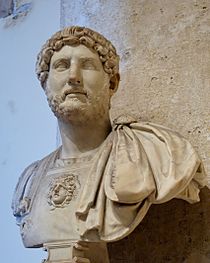
Temple of the Deified Hadrian Restored
Rome is a city of architectural layers. Since antiquity, pieces of the city have been reused and incorporated into newer structures. Some early examples of this process would be the building of the Aurelian Wall, which incorporated existing buildings along its stretch, or the Arch of Constantine, which reused sculptural elements from previous reigns. Many later examples of this process are evident today, the Temple of the Deified Hadrian being among them. Built in 145 CE by Antoninus Pius to honor the deification of the Emperor Hadrian, the temple was eventually incorporated into Carlo Fontana's 17th century palace. Today the palace hold the stock exchange, with the still extant columns of the temple facing the Piazza di Pietra. Like most ancient marble structures, the remains of the temple have been ravaged by time and the elements, and in the last century, by smog and acid rain. I'm thrilled that Italy, with it's long history of looking the other way when it comes to monument repair, has spent 1 million Euros on the temple's restoration. The Temple of the Deified Hadrian, like all of Rome's monuments, is an important piece of history. It is our job to protect these remnants of the past so future generations can enjoy them and learn from them. I hope that this latest effort is a sign of Italy's renewed interest in historical preservation.
Thursday, September 11, 2008
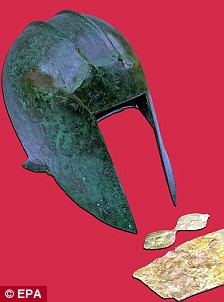
Amazing finds from ancient Pella
The graves recently unearthed in ancient Macedon are truly spectacular. Amour, weapons, gold, pottery; what more could you ask for. The early history of Macedon is incomplete, so hopefully with further study, these new artifacts can shed some light on one of the most important civilizations of the ancient world. Macedon, that uniter of the Greeks (under force) and conqueror of the Persians ushered in a new age, the Hellenistic, changing the shape of Europe and the Near East. The Hellenistic Era brought new heights to the arts and sciences, and set the example that the Romans emulated so well. Understanding the origins of the Macedonians will help complete the picture their history and the history of the Mediterranean world.
Wednesday, September 3, 2008
Large Roman Camp Found in Cumbria
The discovery of a large Roman camp in North Western England is an extremely important find and adds a new piece the the Roman Britain puzzle. As the article states, a Roman presence in that specific area has been hypothesized, but never proven. This camp obviously shows that the Romans where there, but when and for how long remains a mystery. It is interesting to think that this camp may have belonged to the Agricola period or before, but there is no way to tell without digging. I'm saddened to hear that excavations are not planned for this site, but that certainly may change in the future. I know it's impossible to dig up every archaeological site, so for now we'll have to hypothesize about the history of this Roman camp.

Tuesday, August 26, 2008
Sagalassos yields yet another colossal statue

Monday, August 25, 2008
Some museum solutions
In a previous post of mine, I talked about some of the issues I have with art museums. My argument was that art museums, as opposed to history museums, present objects for their aesthetic value while glossing over the historical context in which they where made. Now I know that I may be generalizing and that many art museums do a good job of combining the aesthetic with with contextual, but I feel there is room for art museums to grow without compromising their mission. Let me outline some of my proposed improvements. Keep in mind that I do not want art museums to become history museums; I respect and encourage the idea of the art museum and some day hope to work in one.
Maps - You may think the addition of a map or two would be common sense, but you would be surprised to find out how many art museums don't employ such basic tools. I would place small maps in easy to find areas of galleries; a map of ancient Greece in the antiquities section and perhaps a map of Renaissance Europe in the appropriate gallery. These maps could be small enough and placed well enough so they wouldn't detract from the art on display, which is after all the main propose of the museum. Maps would help the lay person better understand where the objects they are viewing came from, which is of course an extremely important piece of the overall picture. The average person off the street probably doesn't know where Corinth is or isn't familiar with the borders of the Holy Roman Empire circa 1750. These maps shouldn't be a history lesson, but they would help the average museum patron.
Time line - In addition to maps, another important tool for understanding art would be a time line appropriate to the period. Again, these could be small and out of the way, but would help immensely with putting art in it's proper context. The same argument I make for maps applies for time lines, but here I'm talking about historical context as opposed to geographical context.
Diagrams - Again, some museums do this much better than others. A simple diagram goes a long way in telling a story. A step by step display of red-figure vase manufacturing or glass blowing would help translate a piece of art into a living, breathing artifact. I can't stress enough that these diagrams along with maps and time lines should not interfere with the presentation of art as an object; they should merely augment the object and help people better understand it and appreciate it.
For me , art is about more than viewing a beautiful object. Art is meant to be looked at for it's beauty, but that beauty goes beyond the surface. Knowing the story of an object makes the experience infinitely more enjoyable. Artifacts may be prized for their artistic qualities, but it is not until you place them with in the context of history that there true beauty comes through.

Sunday, August 17, 2008
Another colossus from Sagalassos
Last year, a colossal head of the emperor Hadrian was unearthed at Sagalassos in modern day Turkey. I hoped at the time that a partial if not entire giant statue of the emperor would be discovered. Unfortunately, no other remains of the Hadrian colossus, save for his feet and a calf, have been found, but this new discovery sheds light in what else my be buried in Southwestern Turkey. This new giant head, of similar size and style representing Faustina the Elder, suggests that they were probably joined by other members of the imperial "family." I hope the digging continues at Sagalassos so more amazing finds such as this one can be discovered.

Wednesday, August 13, 2008
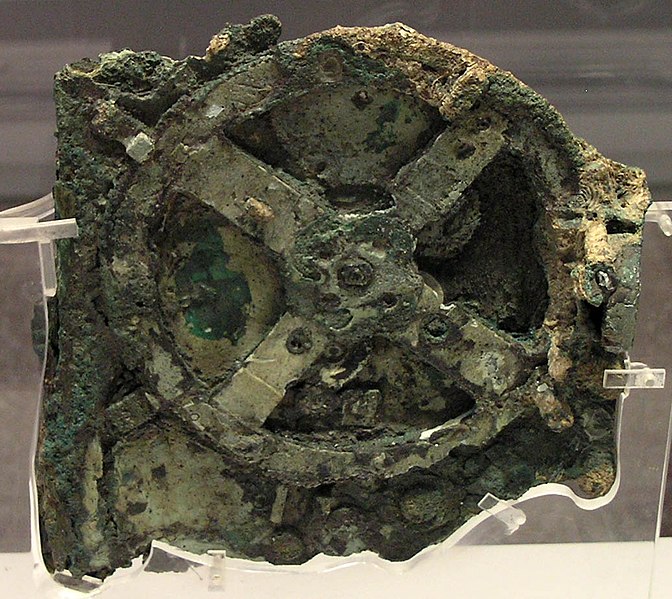
Not quite OS X, but still pretty impressive
The Antikythera Mechanism is an artifact that has awed us since its discover in 1902. What it was used for, when and where it came from are questions that have been debated for decades; the answers of which have helped change our outlook on the ancient world. The recent new discoveries in regards to the mechanism's purpose are fascinating and well timed in lieu of current events. I have come across countless articles about the new Olympic aspect of the mechanism, so I won't attempt to extol these new findings any more here. I will say, though, that the Antikythera Mechanism is a fascinating piece of history that with more research and extrapolation will help enlighten our current understanding of ancient technology.
Wednesday, August 6, 2008
Wie viel ist ein Flugticket nach Xanten?
Speaking of museums! The new museum at the Roman baths in Xanten, Germany appears to be everything I could hope for in a museum and more. Not only is there a large, artifact rich museum to immerse yourself in Roman culture, but the complex houses continued excavations. The building, which melds contemporary architecture with red gabled roofs helps recreate the feel of the original Roman architecture without looking like a theme park. The inside sounds fascinating, though my preliminary Internet research didn't dig up too much information. I did find some pictures, which are linked below. I am happy that a whopping $35 million was invested in this project. A common theme in my blog entries is protecting ancient sites, and I will reiterate that point again. Italy should take pay attention to what other European countries are doing with their ancient sites and take note. I hope to find out more about this new museum, so stay tuned.

Monday, August 4, 2008
Some thoughts on musem exhibits
Say the word museum and I am guaranteed to get excited. I love museums and I'm not ashamed to say it, no matter how nerdy it makes me look. If they would let me, I would probably live inside of one. I have been a volunteer at the Milwaukee Public Museum for just over a year now, and my only regret is that I didn't sign up sooner. The MPM, like most other institutions of it's kind, are amazing places where you can learn just about anything you could imagine. In the middle of downtown Milwaukee, you can hike through a Costa Rican rain forest, you can walk amongst dinosaurs and prehistoric mammals, you can visit 19th century Europe or travel back in time the ancient Mediterranean. It's the latter part, of course, that brought me to the MPM in the first place. Unfortunately there permanent exhibit, Temples, Tells and Tombs, has been closed since last summer and just when it's going to reopen is any one's guess. It was, and hopefully again will be, an extremely well planned and researched exhibit spanning ancient cultures from the Egyptians through the Romans. The museum has a wonderful collection of artifacts, many of which are still on display throughout the museum, but it was the setting of these artifacts that really made the exhibit stand out. I love art museums, but they have always bothered me in the fact that they present artifacts for there sheer artistic importance as opposed to putting them in the context of their place in history. It is true that high quality artifacts from the ancient world are artistic masterpieces and should be treated as such, but something is lost in translation when a red-figure vase is looked at for it's beauty alone. That vase has a story; where it was found, who it was made by, what it was used for, what the story painted on it meant to it's owner. It is the details like these that tell the whole story of an artifact. Temples, Tells and Tombs had artifacts in cases just like any other museum, but it was the maps, diagrams, short history lessons and models that really brought the whole exhibit together. You didn't feel like you where merely looking at artifacts, you where transported back to the ancient world. The antithesis to Temples, Tells and Tombs is evident at the Milwaukee Art Museum. Now, it it's defense, I love the MAM and realize that ancient art is not it's focus. Milwaukee is lucky enough to have the outstanding ancient artifacts on display that we do, but I feel I must voice my opinion. The MAM room as it is, covers Egyptian through Roman art. The collection is small but diverse. The artifacts are displayed in the typical museum style, with placards describing where and when they came from and what they where used for. Unfortunately, that is all. A few maps, maybe a small tutorial on the differences between black-figure and red-figure pottery making would be nice. Something is needed to put the artifacts in their own time and place. They are beautiful for sure; the MAM has a wonderful Hydria by the Niobid painter which is exquisite. But, that Hydria is more than the sum of it's form and design. Now, I'm not saying that art museums should or need to be public history museums like the MPM, but a balance needs to be struck between the contextual and the aesthetic.
Here are some photos from the MPM and MAM exhibits for you to compare:

Subscribe to:
Posts (Atom)


