Julius Caesar has always been one of my favorite characters from Roman history. The story of his life and his rise to power is full of drama and intrigue and his personal desire for success was astonishing. Caesar possessed many rare talents that made him stand out from the crowd, and putting those talents to use made him continually victorious against overwhelming odds. Caesar the man is perhaps not so noble as Caesar the myth, though, and it's important never to look at history through rose colored glasses. For all his famous clemency, Caesar started a war in Gaul out of a desire for personal glory. The Gallic Wars probably cost over one million lives and led to widespread destruction. Caesar also launched the Roman world into civil war to suit his own ends and protect his own interests. Arguing the pros and cons of Caesar's exploits has been discussed in multiple volumes, and I won't try to justify or condemn his actions here.
So, why all this talk of Caesar. A new museum exhibit, of course. "Caesar: The man, the deeds, the myth" is now showing in Italy at the Chiostro del Bramante. According the to the New York Times article below, the exhibit is quite promising. Far too often the public gets the facts wrong about history, and they can't necessarily be blamed. Gladiator and HBO's Rome are sensational, but tend to distort facts. Movies and shows like those are necessary to spark people's interest, but it's up to scholars and museums to make clear the fact vs. the fiction. This new Caesar exhibit has a wide range of artifacts spanning Caesar's career, and it is always exciting to see such exhibits brought to the public. I hope this exhibit shows a balanced picture of Caesar though, for to understand the man is to understand all aspects of him, both good and bad.
Tuesday, April 7, 2009
The Many Faces of Julius Caesar

Tuesday, March 24, 2009
Catch of the Day
Bronze statuary was as ubiquitous in the Classical world as Starbucks are today. Ever since people began to mix copper and tin to create bronze, people shaped that bronze into useful tools or decorative ornaments. Think of bronze as the ancient equivalent to plastic if you will. Weapons, armor, statues, lamps, plumbing and everything in between was fashioned out of bronze in the Greek and Roman world. From an archaeological standpoint, bronze can be a big deal. Bronze coins and fibulae are extremely common finds and can serve as time markers, but bronze statuary is very rare and when one is found it can yield much information. In late antiquity and the middles ages, bronze (in particular bronze statuary) was melted down and turned into something considered more useful at the time. As a result, ancient bronze statues are extremely rare today and any find can greatly increase our knowledge about ancient art.

Just a few days ago in Greece, a fisherman pulled a 2,200 year old bronze horseman out of the water. He did the right thing and contacted authorities immediately. Study of the statue is obviously just beginning, so we'll have to wait quite a while before any detailed information about it's significance is published. Any bronze statue found today is bound to divulge some information that either confirms or reshapes our current hypotheses in regards to art and archaeology. I hope that this statue is not an isolated find and leads to the discovery of a shipwreck. Many such statues that have been pulled from the sea have led to the discovery of new shipwreck sites. Some very famous statues, though, such as the "Victorious Youth" were isolated finds and no subsequent shipwrecks have been found. It is hypothesized that isolated statues such as this were perhaps thrown overboard in a storm. Whether the bronze horseman is an isolated find or not, I'm looking forward to the stories it has to tell about the ancient world.
Sunday, March 15, 2009
The Ancient World in Technicolor
The most common material associated with the cultures of ancient Greece and Rome is marble. Anyone who has ever visited an art museum has seen countless Greek and Roman heads, torsos and full bodied statues in all of their white, shinny austerity. The image of the ancient white marble statue is extremely pervasive and most people don't realize the truth about these magnificent works of art. Ever since artists in the Renaissance began to look at ancient statuary for artistic influence, they utilized not only the themes and styles of ancient art, but the material as well. The statues that surfaced in the Renaissance for the most part were devoid of paint due to the ravages of time, and it's the starkness of marble that inspired artists of that time. In the following centuries though, it began to be understood that these statues were painted. Statues with their paint still intact began to be uncovered and a more complete picture of what the ancient world looked like began to take shape.

Archaeologists and scholars have known for a long time that the ancient world was one of color, not plain white marble. The public, though, to a large degree still imagines a Rome or Athens that was blindingly white in the mid-day sun. There have been some recent efforts to educate the public about ancient statue painting, the most comprehensive and successful being Gods in Color: Painted Sculpture in Classical Antiquity. This exhibit used state of the art technology to uncover the long lost paint and used fully sized and painted replicas of famous statues to get the point across. The result was amazing. Another recent effort is described in the article linked below. In this case, a team of archaeologists and scholars are attempting to reconstruct a statue of a wounded Amazon which has a considerable amount of paint in situ. The results of this team's work is bound to be another important addition to art history and archaeology.
Friday, February 27, 2009
"Column Wreck" Yields Unique Discoveries
The waters of the Mediterranean hold countless treasures from the ancient world. When most people think about travel in ancient Greece or Rome, they conjure up images of sword and sandal films with their chariots and famous Roman roads. True, both of those this did exists, but sea travel was the "rapid transit" of the day. If you had great distance to travel, boarding a ship was your best bet. Unfortunately (or fortunately, if you're an archaeologist) sea travel was also very dangerous. Coast Guard safety regulations certainly did not exists and weather prediction was far from an exact science. Still, intrepid ancients boarded ships and sailed off. Many ended their journey safely, but it's the ships that didn't make it to their destinations that intrigue us today.

A recently published discovery off the coast of Turkey has once again shown us what lies beneath the waves. This ship, dubbed the "column wreck," contains the remains of a massive marble Doric column. Such things have been found in the past, but this wreck is different. Not only has the location of the marble quarry for this column been identified, but the destination of the column has been ascertained as well. The column was destined for the Temple of Apollo at Claros. Claros has a history dating back to the seventh century BCE and was prosperous throughout ancient history. That this column never made it to Claros probably didn't surprise anyone back then. Sea travel, while it was quick and enabled you to transport large quantities of goods or people, was none the less very dangerous. That danger was probably never far from the minds of anyone who held stake in maritime commerce, but it's those loses that enrich the archaeological record today.
Saturday, February 14, 2009
A New Museum, Sans Star Attraction
It's official; the new Acropolis Museum in Athens is scheduled to open on June 20th. It is definitely an exciting day for Athens and the whole of Greece. The new museum has been much anticipated; ushering in a new era of Greek cultural patrimony. Stunning architecture aside, the museum promises to serve the diverse preservation needs of its collection. The opening of the new museum, though, will be marred by the conspicuous absence of it's star exhibit, the Parthenon Marbles.

As I've mentioned before, and as the media mentions all the time, the Parthenon (or Elgin) Marbles were removed from Greece in the early 19th century at the behest of Thomas Bruce, Earl of Elgin. At the time, and ever since, the removal of the marbles was seen as controversial. To this day, the debate rages on over the legality of the purchase and removal. I've stated my opinions on the matter in a previous post, but let me summarize again. I don't care whether or not the marbles were stolen two hundred years ago. The British have been relatively good stewards of the marbles (aside from some dubious restoration techniques performed by the British Museum). I believe that the marbles have been better off in England than in Greece, but I also believe that times have changed and that the Greeks are much more serious about, and have the capital to support, the preservation of their rich cultural heritage. The new Acropolis Museum is proof that Greece is investing in its future by investing in its past. The British need to realize that they are in possession of stolen property, and the only right thing to do is return it.
As for the marbles themselves, the various architectural elements that make up the Parthenon Marbles are indeed masterpieces. The pediment and metope sculptures are of superb quality and the frieze is a stroke of Phidian brilliance. Anyone who has ever had an art history class has seen pictures of the marbles before, and their significance and beauty are unrivaled. The Parthenon Marbles that remain in Athens will be displayed at the museum along with displays highlighting the missing pieces. Let's hope that one day soon, all the pieces will be reunited.
Friday, January 30, 2009
Looting made easy
Looting; that never ending problem. It's no secret that looting and the antiquities unearthed by looting stain the museum world's reputation today. Names like Marion True and the MET come to mind when looting is discussed. In recent years, many countries have tried to put measures in place (with varying success) to stop looters and drain the illegal antiquities market of merchandise. Apparently, though, some countries are also trying to make it easier for looters to do their work.

Most people associate looting with digging up tombs or hoards and selling off the various artifacts found. Digging a hole is certainly a work out, but cheap none the less. There is also an entire industry built up around the looting of shipwrecks. Though a much more expensive operation, looting shipwrecks can certainly reap great "rewards" for those involved. It can be argued that the waters off Greece probably have the most shipwrecks of any geographical area. And it's those uncounted shipwrecks that are fair game for looters. Once upon a time, the vast majority of Greek's coast was off limits to divers. As a result, valuable shipwrecks were saved from being destroyed. Not so anymore. I'm saddened that a country like Greece, with it's immense cultural history, would put that very history on the line to make a buck. Sure, Greece is in financial straights, but a short sighted solution like opening up the coast to divers could cost the country untold amounts of cultural patrimony.
Saturday, January 24, 2009
Notizie meravigliose

Art museums are usually thought of as stuffy, elitist institutions. You don't go to an art museum to have a good time; you go to an art museum to learn. I've always though that learning is a good time, but I can see where people are coming from when they complain about art museums. Many museums don't go the extra mile in making a visit an "experience." Many do though, and I think that's wonderful. Visiting a museum should be more engaging than simply looking at an artifact behind a glass case. The museum I visit the most, the Milwaukee Art Museum, does a good job of incorporating world renowned art with informative histories, descriptions and displays. If I were in charge, I would go a step further, but that's the topic of a previous post.
What the Palazzo Massimo is doing is a great. The many art museums in Rome have always had a bad reputation, not for lack of amazing art, but for multi-hour queues and stuffy atmospheres. That's all about to change, at least at Palazzo Massimo. The Palazzo Massimo alle Terme museum is only ten years old, but it holds an amazing collection of Republican/Imperial/Late Roman art. Their new attitude on the museum "experience" is one that will hopefully be copied by the many other great institutions in Rome and around the world.
Monday, December 29, 2008
Shedding Light on Ancient Women
Women have been marginalized throughout history. Ancient Greece and Rome, hailed as paragons of western civilization, were not immune from misogyny. It can perhaps be argued that women weren't as bad off as some historians may claim, but truth be told, women and men were far from equal. Until the last few decades, the study of women's role in history was negligible. Besides taking a look at the most famous females of antiquity, every day women (and men for that matter) didn't fit into the upper class/white/male viewpoint on history. Times are different now, and movements like Engendering Archaeology and Post-processual Feminism have allowed us to take a scholarly look at ancient women and the role they played.

The new exhibit at the Onassis Cultural Center, Worshiping Women: Ritual and Reality in Classical Athens, looks like a wonderful experience. Women of the past deserve to have their story told, and this exhibit appears to do that story justice. I'm surprised that it took until 2008 to see such an exhibit come to light. I'm always excited to see new exhibits focused on the ancient world, especially when they appear to be of this high a caliber.
Tuesday, December 16, 2008
New Discovery of Roman Lamps
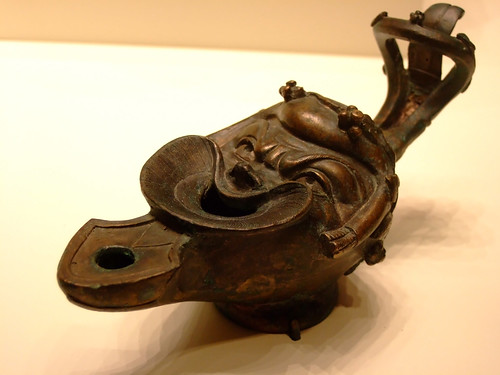
Pottery is a blessing for archaeologists. Short of grinding pottery into dust, it is practically indestructible. Also, pottery can be a wonderful dating tool, as styles tended to change often and relatively uniformly. This latest find in Italy is another example of how pottery shapes our perception of the ancient world. Lamps in the Roman Empire were as common as they are today (albeit of a different kind), and made in equally diverse shapes and sizes. Lamps, being a necessity, were made to suit all budgets (see below) and some very plain as well as outrageously ostentatious examples have been found. Its interesting to think of the different name brands and trendiness in pottery manufacture in the ancient world. It just goes to show that no matter how much people have changed over the past 2,000 years, there are parts of us that are still the same.

Friday, December 12, 2008
Who owns Apollo?
The looting of antiquities is an ongoing problem that plagues us today, and it is a issue that I have talked about in this blog before. The question of "who owns the past" is seemingly impossible to answer, and I certainly don't claim to know how the issue should be resolved. One thing I do know is that politics and scholarship are not good bedfellows. Take the Cleveland Museum of Art for example. In their possession is a bronze sculpture of Apollo possibly made by Praxiteles himself. For those of you who don't know, Praxiteles is one of the most famous Ancient Greek sculptors, and original large bronze sculpture from Ancient Greece is extremely rare. The valuable bronze of ancient statues was too easy a target for later smelting. A good deal of our knowledge of Greek bronzes comes from Roman copies made of marble. Now, the true identity of the Cleveland Apollo's sculptor is in question, but an important chance to study the work in comparison with Roman copies of Praxiteles' work has been lost due to politics and the international illicit antiquities scandal. Instead of recapping what happened here, please read the link below for full details. To make a long story short, the Cleveland Apollo was shunned from a Louvre exhibit on the famous sculptor due to unsubstantiated claims by Greece that the statue was illegally looted. It is a shame that a wonderful opportunity for scholarly research has been blocked by the ongoing international antiquities scandal. When a country of origin can make claims with no evidence that an object has been looted, and the repercussions of those allegations lead to stifled research, a sad day has indeed come.

Also, the Cleveland Museum of Art has agreed to return 14 works of art to Italy that were proven to be acquired illegally. In contrast to the Cleveland Apollo, if artifacts can indeed be proven that they were looted, they should be returned to the country of origin.....to a point. I know what a divisive issue that is, and I will dwell on it more in depth at another time.
Subscribe to:
Posts (Atom)