Rome has been in the process of expanding its subway system for years now. The process is painfully slow (from the perspective of engineers) since every time a shovel is stuck in the ground, ancient artifacts are found and archaeologists must be called in. The subway tunnels themselves are far below the oldest strata of the city, but the locations of stations require digging from the top down. One such site may yield some exciting new discoveries in the near future. Work is slated to begin on the former site of the Forum of Peace. This Imperial forum and corresponding temple was once home to the giant marble map of the ancient city known as the Forma Urbis Romae. About 10% of the map exists today, but archaeologists are hoping to find more once excavations begin. They also hope to learn more about the forum and temple which housed the map.
Thursday, August 26, 2010
New Pieces of Roman Puzzle Wait to be Found
Though we know much about the layout of ancient Rome, there are many questions that remain unanswered. You can stroll through Rome today and see many ancient sites, but one must always remember that most of the ancient city is below one's feet. Centuries of sediment buildup mean that the terra firma that Romans walked on is sometimes meters below the current ground level. The existing fragments of the Forma Urbis Romae give us a clear picture of how the ancient city was laid out, and any new fragments would add greatly to our knowledge.
The Forum of Peace was finished in 75 CE by the emperor Vespasian to commemorate his victories in Judea. The forum/temple complex was built adjacent to the Republican Forum, Forum of Julius Caesar and Forum of Augustus. In later years this area was see even larger and more splendid forums built by succeeding emperors. The Forma Urbis Romae was installed much later, finished in 211 CE by the emperor Septimius Severus. The map measured 60x45 feet and comprised of 150 carved marble slabs. The city was depicted in its contemporary layout, circa early 3rd century CE. Like many ancient artifacts and buildings made or marble, the map fell victim to Medieval plundering and destruction. Fragments began to be excavated during the Renaissance and today we have an assortment of 1,186 fragments.

Friday, August 6, 2010
The Peroni Colosseum
 Here in Milwaukee, we are no strangers to corporate sponsorship. Miller Park, home of the Milwaukee Brewers, bears the name of, you guessed it, Miller Brewing Co. The signs are certainly big enough, so there's no doubt as to who helped finance the stadium. We've also got the U.S. Cellular Arena and the Bradley Center (named after its locally famous benefactor), where the Bucks play. I have no problem with breweries or cellphone providers plastering their names on sports complexes. Often, their capitol is needed for these buildings to be constructed in the first place, and they rightly expect a little advertising in return. Could the Colosseum soon join the ranks of corporately sponsored sports arenas?
One would think that the best way to maintain ancient monuments and sites is to throw money at them, and one would be right. Unfortunately, money is often hard to come by, especially in Italy. The Italian government just doesn't have the money to maintain its huge catalog of archaeological treasures. Admission is already charged at most famous sites, like the Colosseum and Pompeii, but ticket sales aren't enough. What is Italy's solution? Advertising. Italy hopes to find a corporate sponsor to spend over $30 million to restore the Colosseum. For that hefty fee the yet unnamed sponsor will get the right to print their logo on Colosseum admission tickets, place posters around the base of the building and conduct their own private tours. Miller Park is one thing, but the Peroni Colosseum? While I am not thrilled with this latest development, I understand its necessity. I only hope that a balance can be found between corporate investment and scholarship. Scholarship should never take a back seat to corporate interests, and I hope that whoever decides to fund the Colosseum restoration understands that they are nothing more than stewards of the building, keeping it safe for study, enjoyment and most importantly, future generations.
The Colosseum, known in antiquity as the Flavian Amphitheater, was completed in 80 CE by the emperor Titus. The project was begun by Titus' father, Vespasian, who wished to replace Nero's Golden House with something more egalitarian. The amphitheater was a Roman invention (the earliest example is found in Pompeii) and was constructed solely for public displays, such as gladiator fights, beast hunts and executions. With seating for 50,000, the Colosseum was the largest amphitheater ever built in the Roman world. It continued to be used through the 6th century CE, after which it fell into disuse, was damaged by earthquakes, and eventually became a marble quarry. The name Colosseum is a reference to the colossal statue that once stood near the arena. The 100 ft. tall bronze statue was built by Nero, in his likeness, and remained through antiquity, though the head was changed to resemble Sol Invictus.
Monday, July 12, 2010
Massive Roman Canal Found Near Portus
 Recently there have been some amazing new discoveries in and around ancient Portus. A Roman amphitheater, an imperial residence, warehouses, burials and statues are among the notable finds in the area. All of these buildings and artifacts help to increase our knowledge of Rome's port and of the Roman world itself. The latest discovery will hopefully shed light specifically on Roman trade and shipping. A massive canal, 100 yards wide, has been unearthed at Portus. The canal is remarkable for its size and also because it will help us better understand the ancient port. In antiquity, Portus was located on the coast and this giant canal was used to connect the port to the Tiber river two miles away. This connection allowed river boats to bypass the tricky mouth of the Tiber. In conjunction with the finding of the canal, archaeologists have uncovered many artifacts relating to trade, especially with North Africa. Portus seems to have many secrets still hidden and I'm looking forward to the next archaeological discovery there.
Ostia, founded in the 4th century BCE, was the original port of Rome and functioned as such through the 1st century CE. By that time, it was clear that new harbor facilities were needed to meet Rome's expanding trade, particularly the massive amount of imports flowing into the capitol. Claudius began construction on a new port a few miles north of Ostia, which was simply named Portus (Latin for port or harbor). This new harbor featured a large mole and lighthouse and greatly increased the amount of ships that could bring goods into Rome. Portus changed little until the reign of Trajan, who felt the need for greater expansion. Trajan had a giant hexagonal port built that was connected to Claudius' port and the Tiber via a large canal. This hexagonal port was lined with docks and warehouses for the unloading and storage of good. By this time, Portus supplanted Ostia as the major port of Rome. Portus remained important through the rest of Roman history, though eventually fell out of use by the 6th century CE.
Today, the name Portus is misleading since the modern coast is about two miles away, due to centuries of silting by the Tiber. Just to the north of Portus is Leonardo da Vinci-Fiumicino Airport, which covers part of the ancient city. The most noticeable feature of ancient Portus is Lago di Traiano, which was built as Trajan's hexagonal port.
Monday, May 10, 2010
Roman Coins as Looted Artifacts
 Should Roman coins be considered looted artifacts? The U.S. government may soon decide that issue. Laws have been in place since 2007 regulating coins from Cyprus and China, but regulations have left out coins from elsewhere, including Roman coins. The law states that people bringing certain Cypriot and Chinese coins into the U.S. must show proof of the coin's provenance. Collectors are worried that Roman coins may be next on the list, and though they have many arguments for their case, they fail to convince. It is certainly true that this issue is not black and white, but I have to take the side of archaeologists and anthropologists. The collectors argue that Roman coins circulated widely in antiquity and their provenance is impossible to determine. They also say that coin collectors are stewards of coins that museums don't want. Both valid points in my book, but there are larger issues at stake here. Including Roman coins in the current law will not end all looting, but it is a step in the right direction.
Coins are the single most valuable artifact used in dating archaeological sites. Coin hunters with metal detectors can rob sites of this valuable information. They can also damage sites in the process of digging up coins. There is nothing wrong with collecting ancient coins, but archaeology shouldn't be compromised in the process. That's what makes this issue so tricky. How do you regulate the thousands of Roman coins on the market? How do you stem the tide of looting, yet keep people interested in ancient coins and in the ancient world? It is impossible to excavate every site where a Roman coin is found, so what's to be done?
The Romans had a rich history in coin production and design. The standard system of Roman currency came about during the Second Punic War with the introduction of the system based on the silver denarius. The four major coins major Roman coins in the Republic and Empire were the silver denarius, the gold aureus (equalling 25 denarii), the bronze sestertius (1/4 denarius) and the as (1/4 serstertius). There was also a lengthly list of smaller coins representing fractions of the sestertius or as. The earliest coins showed the head of Roma on the obverse and the Dioscuri on the reverse. It didn't take long before coins were used to advertise victories in battle or the histories of important families. Senators were in charge of minting (the triumviri monetales), and they used the opportunitiy to depict their famous ancestors on coins. Sometimes the moneyers were creative, playing off puns of their names (like the charming coins minted by Quintus Pomponius Musa). It wasn't until Julius Caesar that a living Roman was depicted on a Roman coin. This practice was continued by the future leaders of the empire, giving us some of the most remarkable coins from the Roman world. Under the emperors, coins became their most effective way of spreading imperial propaganda. Coins depicted the likeness of the emperor or his family members on the obverse and either scenes of victories, deities or important political events on the reverse. Rulers throughout history, including those of today, use the artistic formula laid down by the Romans. Just look at the coins in your pocket and you won't be able to miss the similarities.
Tuesday, March 30, 2010
Domus Aurea Ceiling Collapses
 A section of Nero's Domus Aurea collapsed today leaving a gaping hole in the garden that sits above the buried structure. Luckily, the Domus Aurea was under repairs at the time and no tourists were inside, and as of the latest reports, no one was injured. Water damage is the likely cause of the collapse and the integrity of the entire structure is now in question. Damage is nothing new to Nero's palace, which was destroyed not long after it was built. Some parts of the structure were buried and those are the areas people can visit today. For decades, though, the structural integrity of the palace has been in doubt. Water damage and algae infestations have closed the site in the past, sometimes for years, and it it any one's guess how this new disaster will effect the future of the site.
Unfortunately, money is most likely at the root of today's collapse. Italy, Greece, Turkey and many other nations around the world are in the unenviable position of having a rich cultural heritage without possessing the means to protect it. These countries have hundreds of acres of exposed archaeological sites that require, above all else, money to maintain. Pompeii is perhaps the most famous example. There you have a small city that requires constant maintenance and millions of dollars just to keep it from falling apart, let alone preserved. Where this money is supposed to come from is a good question and one that will probably be asked again after today's collapse. Finding money for the preservation of ancient sites is sometimes quite difficult. In countries like Italy, which is inundated with archaeological sites, how is the country supposed to support them all? Not too long ago when Italian authorities started charging admission to the Roman Forum, people were far from pleased. In reality, though, sites like the Forum can't exist as archaeological parks free and open to everyone. People can't be trusted to leave ancient monuments well enough alone and lack of funds only serves to damage sites for future generations.
Of course, I must give you a history lesson. Nero stared construction on his Domus Aurea (golden house) after the great fire of Rome in 64 CE. The fire cleared large areas of timber construction, giving Nero the room to pursue his architectural fantasies. Unfortunately, not much of the original structure remains and little has been excavated; much was torn down in antiquity or is now covered by post-antique construction. It is estimated that the Domus Aurea was between 100 and 300 acres in size and according to ancient sources (and archaeological remains) it was richly decorated. It obviously wasn't made entirely of gold; the name stems from the rich accouterments and gilding that was found throughout the palace. Other famous attributes of the Domus Aurea were of course the revolving dining room, the Colossus of Nero and the large lake. For all its splendor, the Domus Aurea was short lived. Nero committed suicide in 68 CE and the victor in the civil war that followed, Vespasian, was a different kind of man and emperor. Vespasian rightly viewed the Domus Aurea as a contemptible exercise in greed and excess. Vespasian would gain fame by converting the site of Nero's lake into the Colosseum, the name of which was derived from the Colossus of Nero that stood near by. The colossus remained, but its dedication to Nero did not; it was rededicated to and altered to look like the sun god Helios. Today, the only accessible areas of the Domus Aurea are beneath the Baths of Trajan. These remains house wonderfulFourth Style frescoes that helped inspire Renaissance and Neo-Classical artists.
Saturday, January 30, 2010
Source of the Aqua Traiana Found
 Aqueducts are among Ancient Rome's most famous engineering achievements. Today, many impressive ruins can be seen throughout the Roman world, including in Rome itself. In fact some Roman aqueducts are still used today, including the restored Aqua Virgo and Aqua Traiana, which feed the Trevi Fountain and Fontana dell'Acqua Paoa respectively. Famous as they are, some Roman aqueducts have also held an air of mystery. The source of one aqueduct in particular, the Aqua Traiana, has long been a secret. Lake Bracciano has fed the aqueduct since ancient times, but the Aqua Traiana's exact starting point has been unknown until now. On the shore of Lake Bracciano, a pair of amateur archaeologists have discovered underground chambers, beneath a 13th century church, which they believe is the source of the aqueduct. The chambers exhibit typicall Roman opus reticulatum masonry and vaulted ceilings. The team's findings have yet to be confirmed by professional archaeologists, but if this is the true source of the Aqua Traiana, it would be an amazing find.
Aqueducts were common not only in the city of Rome, but were an instrument of 'Romanization' throughout the Mediterranean. The first aqueduct built in Rome was the Aqua Appia, built in 312 BCE. Aqueducts were usually named for the person responsible for building them, in this case the Appius Claudius Caecus the Censor. Many aqueducts were constructed during the Republic, and once emperors came to power, aqueducts were often named after them: the Aqua Claudia, finished by Claudius and the Aqua Traiana, built by Trajan. By the time the Aqua Alexandrina was built in 226 BCE, there were 11 aqueducts feeding Rome. The fresh water brought into Rome by these engineering feats greatly helped sanitary conditions in Rome and after the fall of the empire, such measures would be neglected for centuries. In the provinces, aqueducts helped spread sanitation and Roman culture. Some famous examples are the Nimes aqueduct (known for the Pont du Gard) and the aqueduct in Segovia, Spain.
Aqueducts in general are more impressive to an engineer than anyone else. Most are simply masonry channels that carry water from one point to another, with a very slight gradients. What is most impressive today are the massive structures built to compensate for terrain. Valleys and gorges had to be tamed in order to keep gravity working in the aqueduct's favor. The Pont du Gard in France is probably the most famous example of this type of architecture, which is synonymous with Rome itself. These structure are what people think of when they hear the word aqueduct, but in reality these bridges only represent tiny stretches of aqueducts, which are usually tens of miles long.
Saturday, January 16, 2010
Where do Artifacts Belong?
 Italy is at it again. This time their target is the famous 'Victorious Youth,' currently located at the Getty Villa in California. The statue is exceptional in the fact that it is bronze and Greek, a very rare combination in surviving ancient art. Italy's case is this: the statue was fished out of the sea near Fano, Italy in 1964 and subsequently illegally smuggled out of the country, later to be purchased by the Getty. The Getty's version is the same, minus the 'illegally smuggled' part. I'm sure both sides have what they believe to be concrete evidence supporting their case and it's going to be difficult to determine who acted in good faith and who didn't. The Getty's track record regarding stolen antiquities is certainly tarnished, but the Italians may also be accused of trying to drain other countries of antiquities for their own political purposes.
Does it matter that the 'Victorious Youth' may be stolen? Of course it does. Looting archaeological sites for objet d'art is not only illegal, but it irreversibly damages the archaeological record and prevents us from learning more about the past. Ancient art is concerned with far more than just aesthetics. Examining ancient art in context can tell us a great deal about the ancient world as a whole. So, if the 'Victorious Youth' was stolen, then what? Should it be returned to Italy or left in California? These are hard questions to answer but there are several things to take into consideration. First, who has the right to 'own' our cultural heritage and does it matter who owns it? Just because the current Italian state resides on the same land that the Romans did doesn't necessarily make them cultural heirs. The Roman Empire was huge, covering land from Scotland to Iraq. So who gets to claim they are the cultural heirs of Rome? Also, this is a Greek statue we're talking about, one that was probably stolen by the Romans. Does Greece have a claim to this statue then? The important issue here is the study of the statue and its treatment. If Italy had the statue, would it be as well cared for and studied as it has been at the Getty? I don't see why the Getty can't admit wrongdoing (if that was the case) yet still keep the statue. If Italy was actually concerned with the welfare of the statue, they should be happy that it has been so well cared for.
The 'Victorious Youth' is seen by tens of thousands of tourists a year, exposing them to ancient art and culture. Ancient artifacts are meant to be studied, appreciated and shared. What would Italy, especially Fano, do with it? Political bickering and scholarship don't make good bedfellows. Italy may posture all it wants, but what is really at stake here is something beyond national pride. What Italy and other countries should be doing is focusing their efforts on illegal looting and smuggling that's happening right now. Museums across the world have put in place strict guidelines regarding the purchase of antiquities to help stem looting. Punishing institutions for what they did in the past, under leadership that's long gone, is not the way to fix the problem. A mass exodus of antiquities from world museums is also not the answer. Did the Getty buy stolen goods? In the case of the 'Victorious Youth,' perhaps and in other cases most definitely. The question of who owns such artifacts is debatable and I'm not prepared to answer it. What I do know is that scholarship should have no national boundaries and that Italy's demand that the 'Victorious Youth' be given to them is not productive.
Saturday, January 9, 2010
Ancient Roman Perspectives
 Art is meant to be seen. If you go to any art museum, you will see throngs of people examining all types of art, often contorting themselves to get the right perspective or to see certain details. I'm guilty of this; I can only image what the museum guards think of me as I twist my body and practically do handstands to get a certain exact view of some Roman statue or Greek coin. How people interact with art is a big part of my interest in ancient art. In particular, I am interested how ancient people viewed their art, why they created it and what it meant to them. Today, we view ancient artifacts in a museum setting, thinking of them as relics from a lost world. To the ancient Greeks and Romans, thought, their art was contemporary and alive, created for their every day use. How ancient people viewed their art can tell us a lot about their perspectives, but unfortunately literary evidence on such perspectives is scarce. We must instead look at the archaeological record and disseminate what information we can.
So, how did the ancient audience view their art? That's a question not easy to answers, but Martin Beckmann from the University of Western Ontario is on the case. To better understand how the Romans viewed their art, he examined the Alexander Mosaic, one of the most famous objet d'art of the Roman world. The mosaic, from the House of the Faun at Pompeii, was repaired many times in antiquity, and based on those repairs, Beckmann established the zones worn the most by feet. These zones indicate where the most foot traffic was and hence tells us were people stood to view the mosaic. I think his theory is sound and by examining art in this way, we can learn how such works were viewed and what aspects appealed to contemporary audiences. The zones that have the most foot traffic are interesting for several reasons. First, zones 1 and 2 would have given the viewer a panorama of the scene, but it would appear up-side-down. I find this very strange and wonder what Beckmann thinks about this. The other zones are obvious for their placement; they are located near scenes of intense emotion and it is clear that such scenes would have appealed to the Romans viewing the work. What isn't addressed in this article, but which would be of much interest to myself, is the pattern of foot traffic throughout this room and the entire house. Are some of the repair zones merely the result of being passively walked over, not a result of people 'touring' the mosaic? We must always keep an open mind and continually ask such questions to keep scholarship on its toes and to uncover the answers that the archaeological record holds. I think Beckmann's work in wonderful and feel that such research is key to our better understanding ancient art and what it meant to ancient society.
Tuesday, December 1, 2009
The Debate Over Caesar's Head
 When French archaeologists dug up a Roman bust from the bottom of the Rhone River in Arles, I was immediately sceptical about its identification. It was claimed that the bust depicted Julius Caesar and had been produced during his lifetime. Now, two years later, the statue has been restored and studied and scholars are in disagreement over who the bust depicts. Portraits of Caesar are rare and none exist that date from his lifetime (except those on coins). The sculptures that have been identified as Caesar are idealized and it is hard to determine his true likeness.
The archaeologists who found the bust say that it looks like Caesar and is from the mid 40's BCE. I disagree, and I'm not the only one. First of all, the bust was found in the Rhone River out of any discernible context. Without context, little can be known about the statue outside of an art historical perspective. What does that art historical context tell us? The statue is clearly Roman but it is impossible to date down to Caesar's lifetime as claimed by the French. Roman portraiture didn't change much over several centuries and this bust could easily be from either the 1st centuries BCE or CE. Without any context, it's nearly impossible to date the statue to a five year span. Furthermore, the article below quotes one of the French archaeologists dismissing criticism, asking "which noble from Arles would order a bust of himself made in the best, the most expensive and rare marble, and ship it by boat?" I strongly disagree with that statement for many reasons. First, Arles was heavily Romanized in the last 1st century BCE and any aspiring, wealthy citizen would have desired such a bust as a symbol of their position in society. Also, what was the context in which this bust was found? Was it found in a boat, and if so when does the boat date from? Who's to say that this bust ended up on the river bottom in Roman times? I understand that this bust was found on the river bottom, and there are many reasons why it could have ended up their. The only information I have been able to learn is that this bust was found with other Roman artifacts, including a 3rd century statue of Neptune. If there is more detailed information about the archaeological context of this bust, it needs to be published to place the artifacts in context.
Claiming that Roman statues represent famous Romans is a long lived and misguided aspect of art history. From the earliest discoveries of Roman statuary, nearly every statue dug up had a name assigned to it and most of the time the identification was completely arbitrary. The study of coin portraits led to more accurate identification of some statues, mainly emperors and their family, but old habits apparently die hard. Could this bust in Arles depict Caesar? It is possible, but I don't believe the evidence is at hand. Jumping to conclusions does nothing but stand in the way of serious scholarship.
Thursday, October 1, 2009
Nero's Revolving Dining Room Found
 "The main banquet hall was circular and constantly revolved day and night, like the heavens."
-Suetonius, De Vita Caesarum
This short passage about Nero's dining room has made scholars scratch their heads for as long as people have studied Suetonius. What was this room like? What exactly rotated and how did it work? Did the room even exist, or was it another of Suetonius' anecdotes to help paint Nero as a depraved tyrant? These questions may finally receive answers, thanks to archaeologists in Rome. On the Palatine Hill, they have discovered new remains of the Domus Aurea, Nero's golden house. Archaeologists discovered a massive four meter wide pillar which they believe supported the revolving dining room. Like all archaeological finds, there is a certain amount of interpretation involved and this matter can't be seriously discussed until the findings are published (in a peer reviewed journal that is, not an online news source). This find is extremely unique and nothing comparable is know, so it is convincing that this could have been where Nero dined. I'm very excited to find out more about this unique and potentially groundbreaking discovery.
Nero stared construction on his Domus Aurea (golden house) after the great fire of Rome in 64 CE. The fire cleared large areas of timber construction, giving Nero the room to pursue his architectural fantasies. Unfortunately, not much of the original structure remains and little has been excavated; much was torn down in antiquity or is now covered by post-antique construction. It is estimated that the Domus Aurea was between 100 and 300 acres in size and according to ancient sources (and archaeological remains) it was richly decorated. It obviously wasn't made entirely of gold; the name stems from the rich accoutrements and gilding that was found throughout the palace. Other famous attributes of the Domus Aurea were of course the revolving dining room, the Colossus of Nero and the large lake. For all its splendor, the Domus Aurea was short lived. Nero committed suicide in 68 CE and the victor in the civil war that followed, Vespasian, was a different kind of man and emperor. Vespasian rightly viewed the Domus Aurea as a contemptible exercise in greed and excess. Vespasian would gain fame by converting the site of Nero's lake into the Colosseum, the name of which was derived from the Colossus of Nero that stood near by. The colossus remained, but its dedication to Nero did not; it was rededicated to and altered to look like the sun god Helios. Today, the only accessible areas of the Domus Aurea are beneath the Baths of Trajan. These remains house wonderful Fourth Style frescoes that helped inspire Renaissance and Neo-Classical artists.
Tuesday, September 22, 2009
Rare Alexander the Great Gemstone Found
 Alexander the Great is as much a historical figure as he is a legend. Today it is sometimes hard to separate the myth from the man, and even during his lifetime the line between man and mythical hero was vague. The facts we know about Alexander are impressive and it is no wonder that so many fantastic stories sprang up regarding his exploits. He was a master tactician; he conquered the Persian Empire and expanded the boundaries of Greek culture all the way to the Indus River. Authors and generals, both ancient and modern, have studied his tactics and victories. Pompey and Caesar are just a few of the famous men that tried to emulate his greatness. Not only was he a military genius, he was also a playboy. He was young, dashing and oh so handsome. It didn't hurt that he died young either, adding to his legendary appeal.
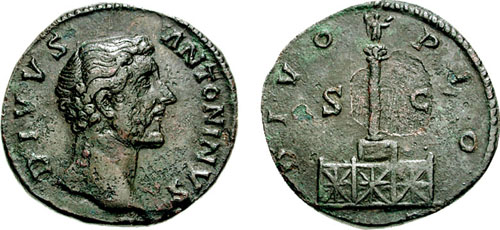
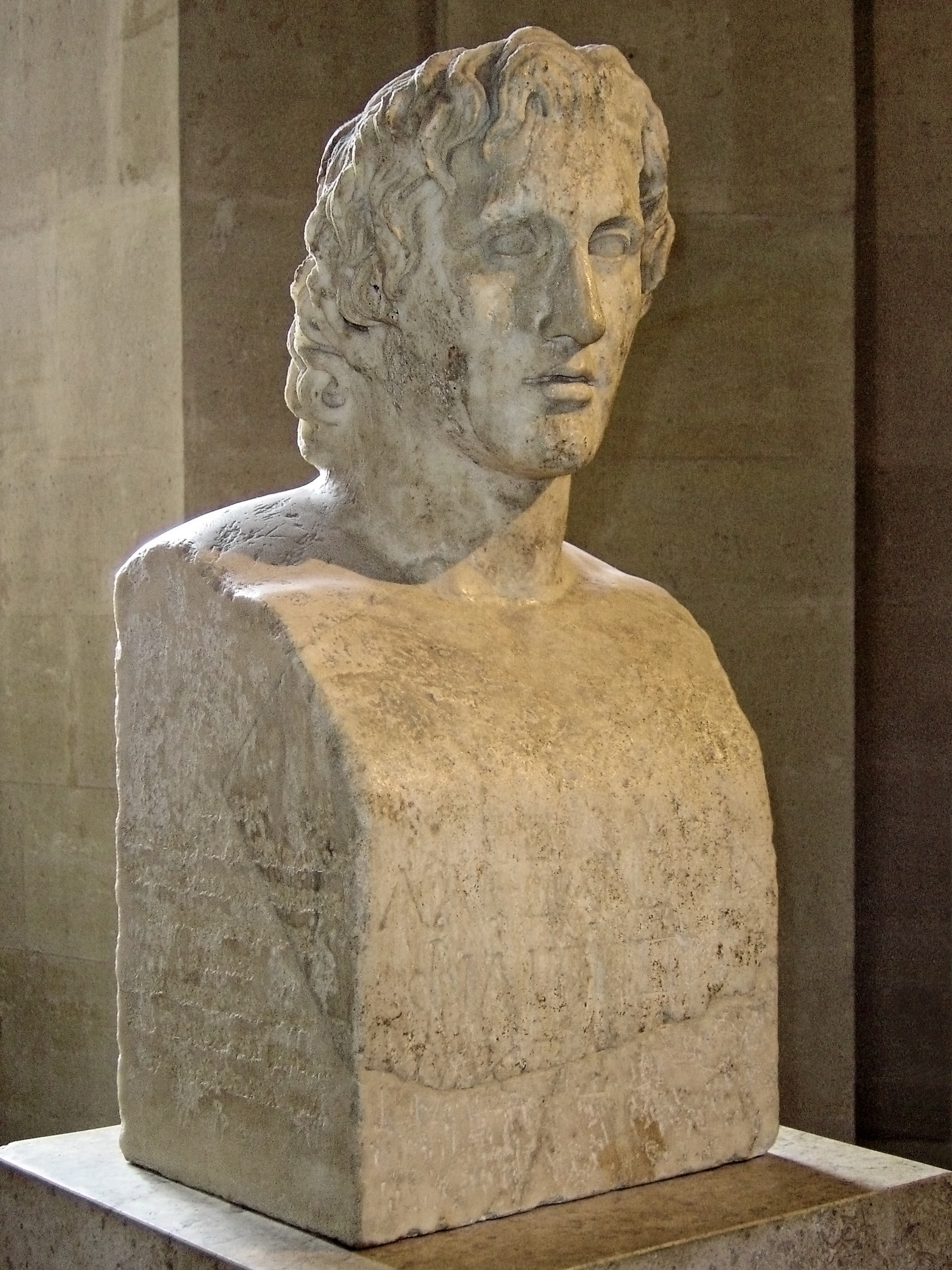
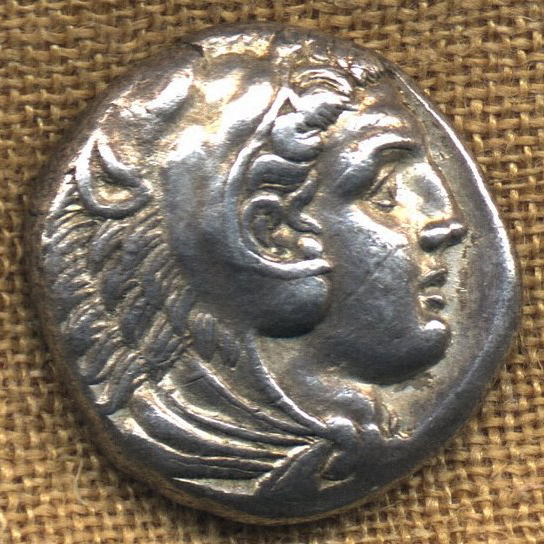
In ancient art, images of Alexander abound. He was a popular subject both during his life and throughout history. The famed sculptor Lysippos was his court artist; the only person Alexander saw fit to translate his likeness to stone. But that didn't stop countless copies from being made during and after his death. When reviewing the catalog of ancient art, you can find an image of Alexander in just about every medium; coins, sculpture, gemstones, etc. Below you can find some examples of these artifacts. The images and legends of Alexander were ubiquitous in the ancient world, just like the names and exploits of Washington and Lincoln are in America today.
Recently a remarkable gemstone carved in the likeness of Alexander the Great was found in Israel. The gem is small, but masterly carved. Such a gem would have been set in a gold ring, which probably would have served as a signet with which to stamp wax scroll seals. Made of carnelian, this gem represents not necessarily that such things were made in the area, but that wealthy residents appreciated such fine objects and had the means to procure them. The gem shows Alexander in profile with a crown on his head. One of the most important aspects of this find is that the gem was actually dug up by archaeologists! So many artifacts in museums today have lost their context, robbing the world of invaluable knowledge. The art of gem carving traces its root back to the Near East, where cylinder seals appear during the Uruk period. Gem carving spread from there to Minoan Crete. We see round and oval shaped gems (like the Alexander gem) being used in 8th century Greece and beyond. Carving on gems became very sophisticated and popular during the Hellenistic and Roman periods. The emperor Augustus is said to have worn a signet ring with the image of Alexander.
Friday, September 18, 2009
Second Century Coin Hoard Found in Israel
 I love Roman coins. The first Roman 'thing' I remember seeing was a collection of Roman coins being sold at a flee market. I was just a kid at the time and didn't know the first thing about the ancient world, but I do remember that the coins I saw looked just like American coins! Roman coins are extremely valuable from historical and archaeological perspectives, since they give us a documented chronology of important events and give us a terminus post quem for dig sites. Coins are also important from an art historical perspective; Roman coins have been the best, and in some cases only, way to assign names to the countless statues of emperors and other important persons. I consider ancient coins invaluable for the reasons above, but they also offer something for the non-scholar. When looking at Roman coins, one can't help but see the similarity between today's currency and that of the ancient world. Ancient coins are great for education because they are so familiar and they can help teach that people in the ancient world weren't that much different than us.
If you go through your change jar today, you'll find coins that are mostly the same. Aside from the redesigned quarters of the past years, most change hasn't changed much. The penny has looked the same for 50 years! Not so in Romans times. In the empire, when a single man held the reigns of power, coinage was the best way to advertise one's self. In an age of no newspapers or TV, everyone still had a pocket full of change. Issuing coins to commemorate both the emperor and important events happened all the time. So it was basically through money that the emperor could articulate to the empire his deeds and accomplishments. Also unlike today, the images struck on Roman coins, during the empire at least, were usually of the living emperor. Today we view coins as more commemorative, honoring great leaders of the past.
The largest Roman coin hoard from the period of the Bar Kokhba Revolt in the 2nd century CE was recently found in Israel. Some 120 gold, silver and copper coins were discovered in a cave and were minted in Israel and abroad. Many of the coins were over-struck with insignia of the Jewish rebels, making this an extremely valuable find. Follow the link below for full details on this exciting find!
Tuesday, September 8, 2009
Colossal Statue Found in Turkey
 If you walked through any city or town during the time of the Greeks or Romans, you would be confronted with statues of all shapes and sizes. Many statues have come down to us through the ages, but some archaeological sites offer better evidence than others as to what the ancient city looked like. When the Persians sacked Athens in the 5th century BCE, they sacked the acropolis, destroying temples and statuary. The ruins the Persians left behind were buried by the Athenians after the war and in more recent times archaeologists have uncovered these same statues, giving us an idea of just how crowded the acropolis once was with them. Other Greek sites such as Olympia and Delphi were congested with statuary, as is attested by literary sources and archaeological remains. Rome followed suit and crowded its forum and beyond with statues of famous men and gods. Statues ranged in size and material, but the most prominent were life size or larger, usually made of bronze or marble. Colossal statuary also existed and two famous examples come to mind that were both made of bronze. One was the Colossus of Rhodes, completed in 280 BCE and considered one of the Seven Wonders of the Ancient World. The other is the Colossus of Nero. Less famous perhaps, this statue was the ultimate manifestation of Nero's arrogance and vanity and was converted to represent the sun god Helios after Nero's death. Most people aren't familiar with this statue but everyone knows of the building that stood next to it. The Flavian Amphitheater was nicknamed the "Colosseum" because of its proximity to the giant statue.
Recently, a colossal statue of the god Apollo was dug up in Hierapolis in modern day Turkey. The statue, made of marble, is now broken in half; the extant portions being the torso and legs. The statue is believed to be from the 1st century CE, placing it in the Roman period, and originally stood around 13 feet tall. Though statues were common in ancient times, a large statue like this would have been special. Perhaps this was a cult image or dedication by a wealthy patron? Apollo was a very ancient god; anyone familiar with the Iliad knows that Apollo played a large role in that book, helping Hector and the Trojans. He was associated with music, art, healing, prophecy and light, just to name a few of the roles he played. Popular during the Greek and Hellenistic periods, Apollo morphed into Roman religion, gaining particular attention during the reign of Augustus after his victories over Antony and Cleopatra were attributed to Apollo. Like all archaeological finds from the ancient world, this statue is just one more piece of the puzzle which will help us understand history that much better.
Thursday, August 20, 2009
A New Theory Regarding Hadrian's Wall
 A recent study claims that the ditch on the north side of Hadrian's Wall originally served as the foundation for a temporary wooden. British archaeologist Geoff Carter believes that the ditch was not used as a defensive barrier but instead is the remains of the wooden wall that preceded the famous stone wall. In Carter's hypothesis, the wall's milecastles were built first (of stone) with a wooden wall spanning the distances between them. After the mile castles were completed, the wooden wall served as a temporary defensive barrier while the stone wall was being constructed. It was previously believed that the ditch and corresponding post holes were part of a defensive barrier in front of the stone wall, a view that is being challenged by Carter. Hadrian's Wall was not constructed as a massive defensive barrier but as a permanent, permeable border, though it is still believed to have had considerable defensive barriers in the form of ditches in front of the wall. Only further studies will determine how Carter's theory is compatible with current views on the wall's defenses.
The emperor Hadrian acted in marked contrast to his predecessors by halting imperial expansion. Upon his succession, he quickly abandoned Trajan's territorial gains in the east, correctly determining them to be unsustainable. During his reign, Hadrian was faced with military troubles from many regions in the empire and it was decided that Scotland was a prize not worth fighting over. Starting in 122 CE, a temporary wooden wall was constructed from coast to coast in northern Britain, to be followed by the stone wall that is a well know landmark today. The wall was just over 73 miles long and is thought to have been around 20 feet tall. Forts were incorporated into the wall every Roman mile (called milecastles) and there were also forts located north and south of the wall.
Though a monumental building project, the fate of Hadrian's Wall was in jeopardy not long after his death. In 138 CE the emperor Antoninus moved the border 100 miles north of Hadrian's Wall, building a new turf wall known to history as the Antonine Wall. This wall was short lived though, being abandoned forever in 164 CE in favor of Hadrian's Wall. The garrisons along the wall faced several attacks in the late 2nd century CE and much of the wall was restored under the emperor Septimius Severus. The wall continued to be used as the border between Roman Britain and the unconquered north until the Romans withdrew from Britain in 410 CE.
Saturday, August 8, 2009
Possible Imperial Villa Found
 An enormous Roman villa has recently been unearthed north of Rome in the Sabine Hills. Dating from the 1st century CE, the villa is believed to have been the country home of the Emperor Vespasian. Archaeologists at the site say the that the size and location of the villa point to Vespasian, though they admit that they have found no inscriptions or any other archaeological proof as to the owner's identity. Though this discovery is indeed special, it demonstrates a phenomenon that has been going on in classical archaeology since the birth of the field. Throughout the history of of Greek and Roman archaeology, erroneous attributions have been made to artifacts without any justification what so ever. Heinrich Schliemann and his "Mask of Agamemnon" comes to mind as an early example. Also, the countless number Roman statues attributed to famous people is astonishing. It was common practice one upon a time to dig up a bust and proclaim that it represented whoever you thought it did. Many positive identifications of Roman statues have been based on coin portraits, but that is a more recent science. You can still go to museums today and find a "Marius" or "Brutus" statue that could in reality be anyone.
I'm not saying that the villa found in Italy is not Vespasian's, but I am saying that simply finding a sumptuous villa in the Sabine Hills does not mean that it was the home of an emperor. If there are more facts to support the hypothesis that the villa belonged to Vespasian, where are they? I realize that a Discovery Channel story isn't the proper venue to document archaeological discoveries, but I'm suspicious when claims are made with little to no evidence presented. I don't particularly blame the archaeologists for making such a claim; I'm sure the excitement of the dig is overwhelming. Also, headlines stating that you've found an emperors villa are far better than saying you've found "some guy's" villa. I guess you could say headlines first, facts later.
Now for a little about Vespasian, or Titus Flavius Vespasianus to be precise. Vespasian was born in 9 CE during the reign of Augustus. Growing up during the reign of the Julio-Claudians, he probably never thought about becoming emperor himself. After obtaining public offices and military posts, Vespasian took park in Claudius' invasion of Britain in 43 CE as Legate of the Legion II Augusta. After Britain he became Consul in 51 CE, after which he retired from public service only to hold office again in 63 CE, this time as governor of Africa. After returning from Africa, Vespasian joined Nero on his tour of Greece. It was there that Vespasian apparently fell asleep during one of Nero's performances, ending his political career. In 66 CE, Vespasian's political exile ended with his appointment to Judea to suppress the revolt there. The appointment Judea was to prove fortuitous, for it was from here that Vespasian got to watch the downfall of Nero and the subsequent civil war from a distance. Always the popular general, Vespasian was urged by his troops to seek the purple and he actively did so in 69 CE. While Vespasian remained in Egypt to secure the grain supply, his forces were put under the command of Marcus Antonius Primus, who defeated Vitellius and secured Rome for Vespasian. The next ten years were spent undoing the extravagances of Nero and the crippling bankruptcy of the civil war. Vespasian died in 79 CE having set the stage for his sons Titus and then Domitian to succeed him. Despite his many achievements, Vespasian is probably best remembered by the world as the man who built the Flavian Amphitheater, known today as the Colosseum.
Tuesday, August 4, 2009
Enjoying "Playful Idleness"
 Several years ago I went to Madison to see In Stabiano at the Chazen Museum of Art. The exhibit showcased frescoes and artifacts from ancient Stabiae, which was destroyed in the 79 CE eruption of Mt. Vesuvius. The exhibit was a delight; gorgeous frescoes covered the walls with marble sculptures and bronze artifacts interspersed, all in Madison care of the National Archaeological Museum of Naples. There was even a recreation of a triclinium with the original wall paintings assembled in their correct order so when you entered, you actually got the feeling of being in the ancient room. I'm not aware of any attendance figures, but I can only imagine that In Stabiano was a success for the Chazen. Though seeing such artifacts was a rare treat for me living in Wisconsin, the residents of Italy can see them at their leisure. The New York Times reports (see below) that Ravenna is home to a new exhibit entitled Otium Ludens (Latin for "playful idleness") which features nearly 200 wall paintings, many of which I was fortunate enough to see at the Chazen. The exhibit looks like yet another great collection of Roman art that will be displayed around the world; the New York Times states that the exhibit will travel from Ravenna to Toronto, Melbourne, Sydney, Madrid and Valencia.
Ancient Stabiae is located on the Gulf of Naples on a cliff overlooking the sea. The views are as amazing today as they were in antiquity and it is no surprise that Stabiae was the playground of the rich and famous. Several palatial villas have been excavated there and the quality of art discovered rivals any in the Roman world. Stabiae started out as a small Oscan port in the 6th century BCE. After its sacking in 89 BCE by Sulla during the Social War, Stabiae was reconstructed and began its life as a rich resort town. Stabiae remained a retreat for wealthy senators and the Imperial family until its destruction in 79 CE.
Though many works of art have been discovered in Stabiae, it is often overshadowed by its more famous neighbor Pompeii. In fact, the eruption of Mt. Vesuvius destroyed many towns in the area and all have produced amazing archaeological finds. The area to the south of Vesuvius bore the brunt of the destruction; it is here that Pompeii, Oplontis and Stabiae lie. Herculaneum, which lies to the west of the mountain, was also destroyed. Fortunately for the residents of nearby Neapolis (present day Naples), the mud and pyroclastic flows of the eruption traveled away from their ancient city.
Subscribe to:
Posts (Atom)