If you walked through any city or town during the time of the Greeks or Romans, you would be confronted with statues of all shapes and sizes. Many statues have come down to us through the ages, but some archaeological sites offer better evidence than others as to what the ancient city looked like. When the Persians sacked Athens in the 5th century BCE, they sacked the acropolis, destroying temples and statuary. The ruins the Persians left behind were buried by the Athenians after the war and in more recent times archaeologists have uncovered these same statues, giving us an idea of just how crowded the acropolis once was with them. Other Greek sites such as Olympia and Delphi were congested with statuary, as is attested by literary sources and archaeological remains. Rome followed suit and crowded its forum and beyond with statues of famous men and gods. Statues ranged in size and material, but the most prominent were life size or larger, usually made of bronze or marble. Colossal statuary also existed and two famous examples come to mind that were both made of bronze. One was the Colossus of Rhodes, completed in 280 BCE and considered one of the Seven Wonders of the Ancient World. The other is the Colossus of Nero. Less famous perhaps, this statue was the ultimate manifestation of Nero's arrogance and vanity and was converted to represent the sun god Helios after Nero's death. Most people aren't familiar with this statue but everyone knows of the building that stood next to it. The Flavian Amphitheater was nicknamed the "Colosseum" because of its proximity to the giant statue.
Tuesday, September 8, 2009
Colossal Statue Found in Turkey
Recently, a colossal statue of the god Apollo was dug up in Hierapolis in modern day Turkey. The statue, made of marble, is now broken in half; the extant portions being the torso and legs. The statue is believed to be from the 1st century CE, placing it in the Roman period, and originally stood around 13 feet tall. Though statues were common in ancient times, a large statue like this would have been special. Perhaps this was a cult image or dedication by a wealthy patron? Apollo was a very ancient god; anyone familiar with the Iliad knows that Apollo played a large role in that book, helping Hector and the Trojans. He was associated with music, art, healing, prophecy and light, just to name a few of the roles he played. Popular during the Greek and Hellenistic periods, Apollo morphed into Roman religion, gaining particular attention during the reign of Augustus after his victories over Antony and Cleopatra were attributed to Apollo. Like all archaeological finds from the ancient world, this statue is just one more piece of the puzzle which will help us understand history that much better.

Thursday, August 20, 2009
A New Theory Regarding Hadrian's Wall
 A recent study claims that the ditch on the north side of Hadrian's Wall originally served as the foundation for a temporary wooden. British archaeologist Geoff Carter believes that the ditch was not used as a defensive barrier but instead is the remains of the wooden wall that preceded the famous stone wall. In Carter's hypothesis, the wall's milecastles were built first (of stone) with a wooden wall spanning the distances between them. After the mile castles were completed, the wooden wall served as a temporary defensive barrier while the stone wall was being constructed. It was previously believed that the ditch and corresponding post holes were part of a defensive barrier in front of the stone wall, a view that is being challenged by Carter. Hadrian's Wall was not constructed as a massive defensive barrier but as a permanent, permeable border, though it is still believed to have had considerable defensive barriers in the form of ditches in front of the wall. Only further studies will determine how Carter's theory is compatible with current views on the wall's defenses.
The emperor Hadrian acted in marked contrast to his predecessors by halting imperial expansion. Upon his succession, he quickly abandoned Trajan's territorial gains in the east, correctly determining them to be unsustainable. During his reign, Hadrian was faced with military troubles from many regions in the empire and it was decided that Scotland was a prize not worth fighting over. Starting in 122 CE, a temporary wooden wall was constructed from coast to coast in northern Britain, to be followed by the stone wall that is a well know landmark today. The wall was just over 73 miles long and is thought to have been around 20 feet tall. Forts were incorporated into the wall every Roman mile (called milecastles) and there were also forts located north and south of the wall.
Though a monumental building project, the fate of Hadrian's Wall was in jeopardy not long after his death. In 138 CE the emperor Antoninus moved the border 100 miles north of Hadrian's Wall, building a new turf wall known to history as the Antonine Wall. This wall was short lived though, being abandoned forever in 164 CE in favor of Hadrian's Wall. The garrisons along the wall faced several attacks in the late 2nd century CE and much of the wall was restored under the emperor Septimius Severus. The wall continued to be used as the border between Roman Britain and the unconquered north until the Romans withdrew from Britain in 410 CE.
Saturday, August 8, 2009
Possible Imperial Villa Found
 An enormous Roman villa has recently been unearthed north of Rome in the Sabine Hills. Dating from the 1st century CE, the villa is believed to have been the country home of the Emperor Vespasian. Archaeologists at the site say the that the size and location of the villa point to Vespasian, though they admit that they have found no inscriptions or any other archaeological proof as to the owner's identity. Though this discovery is indeed special, it demonstrates a phenomenon that has been going on in classical archaeology since the birth of the field. Throughout the history of of Greek and Roman archaeology, erroneous attributions have been made to artifacts without any justification what so ever. Heinrich Schliemann and his "Mask of Agamemnon" comes to mind as an early example. Also, the countless number Roman statues attributed to famous people is astonishing. It was common practice one upon a time to dig up a bust and proclaim that it represented whoever you thought it did. Many positive identifications of Roman statues have been based on coin portraits, but that is a more recent science. You can still go to museums today and find a "Marius" or "Brutus" statue that could in reality be anyone.
I'm not saying that the villa found in Italy is not Vespasian's, but I am saying that simply finding a sumptuous villa in the Sabine Hills does not mean that it was the home of an emperor. If there are more facts to support the hypothesis that the villa belonged to Vespasian, where are they? I realize that a Discovery Channel story isn't the proper venue to document archaeological discoveries, but I'm suspicious when claims are made with little to no evidence presented. I don't particularly blame the archaeologists for making such a claim; I'm sure the excitement of the dig is overwhelming. Also, headlines stating that you've found an emperors villa are far better than saying you've found "some guy's" villa. I guess you could say headlines first, facts later.
Now for a little about Vespasian, or Titus Flavius Vespasianus to be precise. Vespasian was born in 9 CE during the reign of Augustus. Growing up during the reign of the Julio-Claudians, he probably never thought about becoming emperor himself. After obtaining public offices and military posts, Vespasian took park in Claudius' invasion of Britain in 43 CE as Legate of the Legion II Augusta. After Britain he became Consul in 51 CE, after which he retired from public service only to hold office again in 63 CE, this time as governor of Africa. After returning from Africa, Vespasian joined Nero on his tour of Greece. It was there that Vespasian apparently fell asleep during one of Nero's performances, ending his political career. In 66 CE, Vespasian's political exile ended with his appointment to Judea to suppress the revolt there. The appointment Judea was to prove fortuitous, for it was from here that Vespasian got to watch the downfall of Nero and the subsequent civil war from a distance. Always the popular general, Vespasian was urged by his troops to seek the purple and he actively did so in 69 CE. While Vespasian remained in Egypt to secure the grain supply, his forces were put under the command of Marcus Antonius Primus, who defeated Vitellius and secured Rome for Vespasian. The next ten years were spent undoing the extravagances of Nero and the crippling bankruptcy of the civil war. Vespasian died in 79 CE having set the stage for his sons Titus and then Domitian to succeed him. Despite his many achievements, Vespasian is probably best remembered by the world as the man who built the Flavian Amphitheater, known today as the Colosseum.
Tuesday, August 4, 2009
Enjoying "Playful Idleness"
 Several years ago I went to Madison to see In Stabiano at the Chazen Museum of Art. The exhibit showcased frescoes and artifacts from ancient Stabiae, which was destroyed in the 79 CE eruption of Mt. Vesuvius. The exhibit was a delight; gorgeous frescoes covered the walls with marble sculptures and bronze artifacts interspersed, all in Madison care of the National Archaeological Museum of Naples. There was even a recreation of a triclinium with the original wall paintings assembled in their correct order so when you entered, you actually got the feeling of being in the ancient room. I'm not aware of any attendance figures, but I can only imagine that In Stabiano was a success for the Chazen. Though seeing such artifacts was a rare treat for me living in Wisconsin, the residents of Italy can see them at their leisure. The New York Times reports (see below) that Ravenna is home to a new exhibit entitled Otium Ludens (Latin for "playful idleness") which features nearly 200 wall paintings, many of which I was fortunate enough to see at the Chazen. The exhibit looks like yet another great collection of Roman art that will be displayed around the world; the New York Times states that the exhibit will travel from Ravenna to Toronto, Melbourne, Sydney, Madrid and Valencia.
Ancient Stabiae is located on the Gulf of Naples on a cliff overlooking the sea. The views are as amazing today as they were in antiquity and it is no surprise that Stabiae was the playground of the rich and famous. Several palatial villas have been excavated there and the quality of art discovered rivals any in the Roman world. Stabiae started out as a small Oscan port in the 6th century BCE. After its sacking in 89 BCE by Sulla during the Social War, Stabiae was reconstructed and began its life as a rich resort town. Stabiae remained a retreat for wealthy senators and the Imperial family until its destruction in 79 CE.
Though many works of art have been discovered in Stabiae, it is often overshadowed by its more famous neighbor Pompeii. In fact, the eruption of Mt. Vesuvius destroyed many towns in the area and all have produced amazing archaeological finds. The area to the south of Vesuvius bore the brunt of the destruction; it is here that Pompeii, Oplontis and Stabiae lie. Herculaneum, which lies to the west of the mountain, was also destroyed. Fortunately for the residents of nearby Neapolis (present day Naples), the mud and pyroclastic flows of the eruption traveled away from their ancient city.
Saturday, July 25, 2009
Two Exciting New Underwater Discoveries
 The scientific excavation and study of ancients sites around the Mediterranean has been going on for almost 150 years. It's hard not to trip over ancient cities and towns of the Greeks and Romans, not to mention the many other diverse cultures that have thrived throughout history. For centuries the various modern cultures of Europe have been fascinated by the ancient world. This interest was easily fueled by the convenient ruins strung about Europe, especially in cities like Rome and Athens. As far back as the middle ages, we have accounts of ruins and objets d'art being dug up and appreciated. It has not been until relatively recent times, though, that attention was turned away from land and towards the sea. It has never been a secret that the Mediterranean Sea contains countless ship wrecks containing who knows what. Tantalizing clues have occasionally been pulled from the sea floor; the Antikythera Mechanism and the Riace Bronzes come to mind. Scuba diving only became practicable and popular after WWII, so much less time has been spent in dealing with underwater archaeology that traditional land based archaeology. Even today, underwater archaeology is a small specialized field, due mostly to the costs involved.
Two new finds have brought attention to both the ancient world and underwater archaeology. First off, divers off the coast of Squillace, Italy have found what they believe to be the sunken remains of the ancient town of Scylletium. Scylletium was an unremarkable town founded by Athenian colonists probably in the 8th or 7th centuries BCE. Known as the birthplace of the late Roman author Cassiodorus, Scylletium was also claimed by some to be founded by Odysseus. The divers found stones that appear to be man made and are thought to be part of the ancient town.
Another find shows just what kind of archaeological treasures lie beneath the sea. Five Roman ships have been found in what is being called an underwater "museum." The five ships, dating from the 1st to 4th centuries CE, appear to be merchant vessels carrying amphorae and other trade goods. The ships did not capsize when they sank, so their cargoes are relatively intact. The spot where the ships sank seems to be a high traffic area, probably an established trade route. It's finds like this and the one at Squillace that show us how valuable underwater archaeology can be and just how much is out there that has yet to be discovered.
Monday, July 6, 2009
Generous Gift Showcases Roman Mosaic
 The Romans used mosaic art extensively throughout their empire. From Britain to the Middle East, examples of many different mosaic techniques have been discovered. Like much of Roman art, the mosaic technique was something that they absorbed and modified to suite their own artistic needs. The earliest mosaic examples come from Mesopotamia, dating from the 2nd millennia BCE. Those examples are primarily geometric in design using different colored tesserae. The Ancient Greeks embraced mosaics, decorating their floors with geometric designs made of tesserae or pebbles. In the royal Macedonian city of Pella we find some wonderful examples of figurative scenes executed in mosaic and during the Hellenistic period mosaic art would reach a new height. It is from the Hellenistic model that the Romans developed their mosaic art. Many famous Roman mosaics, such as the Alexander Mosaic from Pompeii, are thought to be based on Hellenistic paintings. Pompeii is famous for its many beautiful mosaics, but elsewhere in Italy and throughout the Roman world, many astounding mosaics have been found.
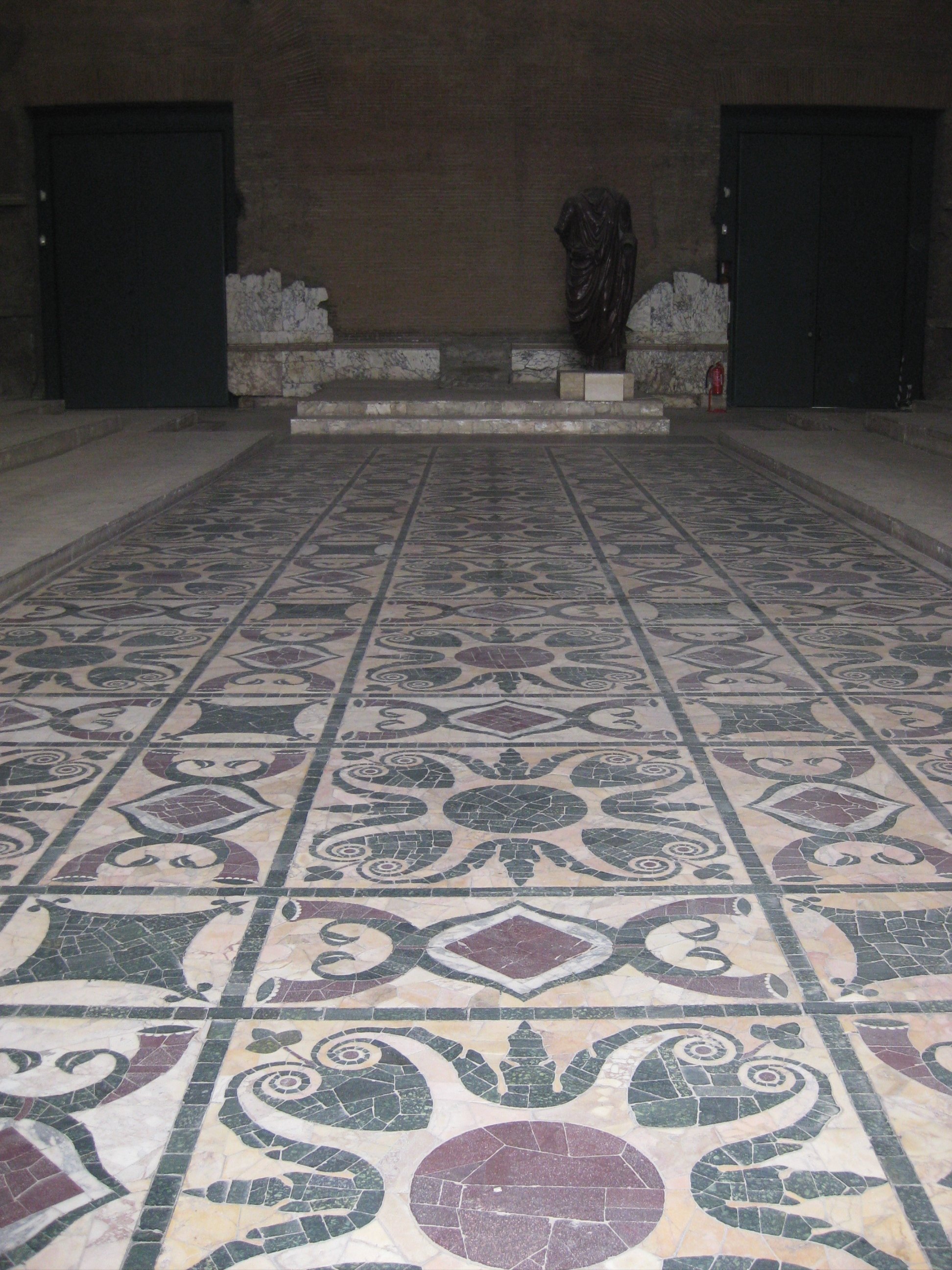
Artistic tastes in Rome fluctuated then just as they do today. First of all there were several different mosaic techniques that were in use, some being more popular than others at different times. The three most popular mosaic techniques were Opus Vermiculatum, Opus Tessalatum and Opus Sectile. Opus Vermiculatum was by far the most sophisticated mosaic technique, utilizing the smallest tesserae in a dazzling range of colors. Many fine examples, such as the Dove Basin Mosaic from Tivoli, showcase this technique. Opus Tessalatum utilized black and white tesserae and was primarily used to form geometric patterns, though figurative scenes using this technique became popular. Opus Sectile focused on patterns made out of large pieces of stone, usually different colored marble. The floor of the Curia Julia in Rome is a good example of this technique. Different techniques were also used in conjunction. An Emblemata was a small, finely made Opus Vermiculatum "picture" that was surrounded by a large area of geometric designs in Opus Tessalatum.
Thanks to a generous gift from the Leon Levy Foundation the Shelby White, Israelis will now be able to view a beautiful Roman mosaic once again. The Lod Mosaic is a huge, 600 square foot mosaic floor dating from around 300 CE. The mosaic was discovered in 1996 but had been subsequently reburied due to lack of funds for its preservation. That has changed thanks to the gift of $2.5 million to the Israeli Antiquities Authority. The money will be used to build a new facility to house and preserve the mosaic. Money for the preservation of the world's ancient sites is always in short supply and it's refreshing to see such generous philanthropy at work to protect the Lod Mosaic.
Thursday, June 25, 2009
Roman Statues Found in Pozzuoli

Despite the rarity of extraordinary, career defining archaeological finds, archaeologists dig up valuable artifacts every day. Value, of course, is subjective; a coarse-ware clay bowl may not have much "value" to an art historian, but it can mean a lot to a cultural anthropologist. Most archaeological finds don't make the news not because they are unimportant, but because they are not exciting to the general public. Every once and a while though, archaeologists dig up something "exciting." Such finds usually revolve around objets d'art simply because people find pieces of sculpture more worthy of their time than a pile of ancient roof tiles. Public disinterest in archaeology is unfortunate, but in my opinion the over-hyped art historical finds benefit archaeology as a whole. Finding a Roman sculpture or Greek vase is the desert after an otherwise bland meal of culturally and historically significant, if not pretty, artifacts. The exposure that archaeology gets when artistic finds surface makes people think about archaeology and hopefully convinces them that archaeology is a good and necessary thing.
Recently, a marble head of the Roman Emperor Titus was found in Pozzuoli. Several other artifacts were discovered, including a marble Gorgon head as well as fragmentary statues, columns and inscriptions. Finds like this are great for art historians and archaeologists, but also good for the public. It is basically good PR for archaeologists to dig up statues and the like. "Visually stimulating" archaeological discoveries help archaeologists justify to the lay masses that what they do is important and should be funded.
We've got his head, but who was he? Titus was the second Emperor in the Flavian Dynasty, which was started by his father Vespasian. Vespasian was the fourth Emperor in the so called Year of the Four Emperors, 69 CE. It all started in 68 CE with Nero's suicide and the subsequent usurpations of Galba, Otho and Vitellius. Vespasian and his son Titus where in Judea at the time, attempting to suppress the Great Jewish Revolt. While in the East, Vespasian was declared Emperor by his troops and he subsequently returned to Rome to establish his position, leaving Titus to finish the Jewish War. Titus finished the war in 70 CE with the infamous siege of Jerusalem and the subsequent destruction of the Second Temple. Returning the Rome, Titus held several governmental offices under his father, including seven consulships. Upon Vespasian's death in 79 CE, the purple was seamlessly transferred to Titus, who would go on to become the darling of the Roman people. Though Titus' reign lasted just over two years, it saw three important events in Roman history: the eruption of Mt. Vesuvius in 79 CE, the opening of the Colosseum in 80 CE and the fire in Rome in 80 CE. Titus died in 81 CE at the age of 41 leaving Rome in the hands of his younger brother Domitian. Domitian was quite a bit different from his brother and father and his rule has been has been compared to those of Gaius and Nero, though recent studies have tried to clear his name, so to speak. Sounds like another post topic to me.
Saturday, June 13, 2009
Rome's Aurelian Wall in Danger
 Societies have long used walls to protect themselves from real or imagined dangers. In the ancient Greek and Roman world, walls were used extensively around cities and towns to act as barriers against attack. Military technology being what it was, walls did a relatively good job at keeping out people who weren't welcome. Not until Rome's sophistication of artillery and siege works did walls loose some of their protective value; but walls continued to be widely employed until the 19th century. Walls were often constructed out of dry or mortared ashlar masonry and many incorporated towers at set intervals as well as gates. Gates grew in size and complexity during antiquity; the double gates of Classical Athens come to mind. It is interesting to note that Sparta never had city walls.
Like most other major cities during antiquity, Rome had its share of walls. The so called Servian Wall was built in the 4th century BCE after Rome was sacked by Gauls. This wall had a circumference of roughly 11 km and enclosed an area of 426 ha. Made of tufa blocks and nearly 10 m tall, little remains of this wall, which served Rome for hundreds of years. By the time of Augustus, the city of Rome had long spread beyond the borders of the Servian Wall and a newer and longer wall wasn't deemed necessary until the 3rd century CE. Due to military pressures existant in the troubled 3rd century, the Emperor Aurelian built a new circuit of walls in 271-75 CE. This new wall was 19 km long and enclosed an area of 1,372 ha, completely enclosing the Servian Wall. This so called Aurelian Wall was made of brick faced concrete with towers every 100 Roman feet and a series of impressive gates. The Aurelian Wall was used through the 19th century CE for the defense of Rome; Cadorna was forced to breach it in 1870 during the Risorgimento. Today the Aurelian Wall is obviously no longer used to defend the city, though much of the wall remains; it's state of preservation due to its long use.
Ruins from ancient Rome are fragile and require diligent stewards to care for them. As I've talked about before, Italy is swollen with ancient sites that not only require watchful eyes but millions of Euros to protect. Recently, some pieces of the Aurelian Wall came crashing down, forcing the closure of a near by street. It's now believed that the remaining sections of the wall may be in grave danger. The cause of the damage? Money, or lack there of I should say. Italy just doesn't appropriate enough funds for the upkeep of it's history, as the condition of Pompeii can attest. Not that the Italian government is entirely to blame; the costs facing it are enormous, especially in this economy. I'm not an economist, but I do realize the importance of history. Ancient sites need protection so we and future generations can learn from them and enjoy them.
Thursday, June 11, 2009
Ancient Scrolls May Soon Reveal Their Secrets
 I have an illimitable appetite for books. I buy books all the time and am always reading at least two are three at once. The knowledge contained in books is certainly their first draw, but my passion for books goes far beyond mere information. I can get information online quicker than in a library or my own bookshelves. Looking at words on a computer screen, though, just isn't the same as holding a book in your hands. There is something romantic about holding a book, feeling it and smelling it (yes, smelling it). Books have their own personalities and I consider them more as companions rather than possessions (who would ever say such a thing about a web-site!).
In today's society you can buy books everywhere and books are written about every conceivable subject. In the ancient world, books didn't exist, let alone paper. Texts were written on scrolls made mainly of papyrus (though parchment, wax tablets and other forms were in use), and such items were reserved for the those wealthy enough to afford them. Publishing as we know it did not exist and scrolls were far less common than books are today. Libraries existed and it was common for wealthy persons to send one of their trained slaves to such libraries to copy texts for the home library (copyright laws didn't exist). Scrolls were covered with text written with no spaces and no punctuation and were not very long; several if not dozens of scrolls were needed for long works. One can imagine the organization required to keep a library, whether public or person, in a condition were anything could be found. I'm sure to the bibliophiles of the day, their scrolls were prized possessions, even more so since every scroll was a unique hand written copy.
Our knowledge of ancient literature is very comprehensive, yet we can only speculate at the amount of works lost to time. The works that have survived are mostly a result of copies made during the middle ages; the original scrolls having long disintegrated. There have been many fragments of scrolls found, mainly in Egypt and the near east, but their number doesn't rival the 1,785 scrolls found at the Villa of the Papyri near Herculaneum in Italy. The scrolls, turned to carbon during the volcanic eruption of 79 CE, were found in the 18th century and have been kept safe in Italy and France since then. Scientists are now trying to "unroll" the scrolls via computer and if they are successful, the world of ancient literature could be turned on it's head. We can only imagine what great lost works are hidden in these scrolls. Of course, they could be nothing more than grocery lists either, but that's not the point. Any written words from the past would help with our understanding of the ancient world. I'm always amazed at what technology can do for archaeology and I hope the scientists and scholars involved in this project are successful.
Friday, June 5, 2009
The Complexities of Roman Religion

The face of religion in Ancient Rome was complex and dynamic. Though the state religion, based on the Greek model, was pervasive throughout the empire, the worship of the Olympians was hardly the only religious practice. To understand religion in the Roman world, you must forget much of what you know about religion today. Religion in the modern sense (in regards to Christianity, Judaism and Islam) is based on sacred texts which dictate moral dogma to the religion's followers and requires those followers to perform codified rituals. The latter applied to religion in Ancient Rome, but no the former. There were no sacred texts in Roman religions and moral behavior was not dictated by religion. Instead of following a certain dogma in order to gain eternal salvation, worshipers in the Roman Empire viewed religion as a means to appease the gods. The gods were seen as fickle and their power unlimited, so placating them was in man's best interest. The purpose of religion was as a safeguard for society; making the gods happy, through sacrifice, prevented them from reigning down wrath upon man. If the gods were happy, man was happy, and if the gods were especially pleased, certain gods might be extremely generous with their benevolence.
There certainly were moral lessons to be learned in Roman religion, but the ultimate goal was somewhat different when compared to modern religions. In the "big three" religions of today, adhering to the moral code laid down by your respective religious text not only benefits you and your fellow man, but is your ticket to paradise. Not so in the ancient world. In the view of Romans, everyone went to the Underworld. Only the most wicked or hated mythological figures went to Tartarus and experienced Hell as we know it. The Underworld was not Heaven as we think of it. Elysium was the island in the Underworld where heroes and virtuous souls spent eternity, but it must be reiterated that Roman religion did not promise a paradisical afterlife. How a Roman acted in day to day life didn't matter when he was dead. The moral lessons inherent in Classical mythology were concerned with the present; offend the gods and they will exact revenge on you. Being a productive member of society was the goal of moral lessons both then and now, but the rewards differ greatly.
Finally, monotheism is the most prevalent type of religion today; in the Roman world, polytheism was the rule. Not only was the state religion made of up dozens of gods, but there were many other religions that people followed in addition to their obligations to the state. Some notable examples from the Greek world include the cults of Dionysus and Demeter. The word "cult" has modern negative connotations and can be misleading when applied to ancient worship, but its use is standard. Both Dionysus and Demeter were long established Greek deities, but their worship was outside of the standard religious practices of both the Greeks and Romans. So called foreign cults were also prevalent in the Roman world. The Egyptian goddess Isis became very popular (see article below) and the worship Mithras from the Near East also flourished. As the Roman Empire spread, soldiers took the state religion with them, but also adopted local gods into their worship, so in far off places like Gaul or Britain, it was not uncommon for Jupiter to be worshiped along side some minor local deity. The Romans also added dead emperors to their list of gods and in some parts of the empire the living emperor was worshiped as divine. So, not only were the Romans polytheistic, they also incorporated other religions into their own or worshiped other gods along side their traditional tutelary deities.
Subscribe to:
Posts (Atom)